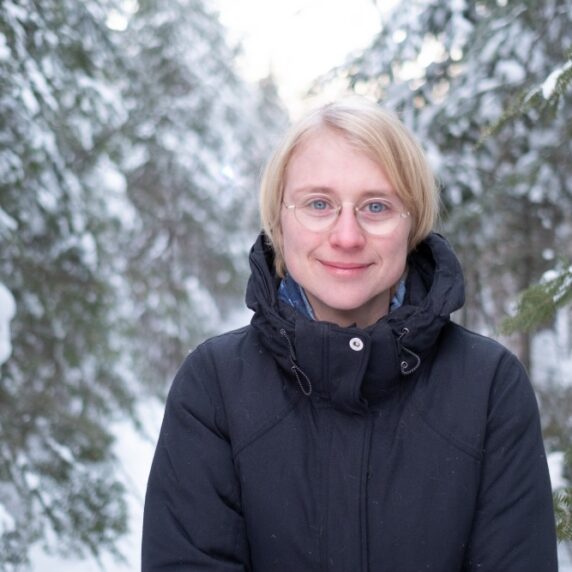
Climate change is transforming northern landscapes in visible and invisible ways. Dr. Élise Devoie works alongside northern communities to understand how these changes are reshaping water systems people and ecosystems depend on every day.
As an Assistant Professor in Civil Engineering at Queen’s University, her research focuses on hydrology and hydrogeology of cold regions — the study of how water moves through thawed and frozen ground, lakes, rivers and wetlands in sub-Arctic environments. She works in partnership with remote First Nations communities in the Northwest Territories to understand how climate change is affecting drinking water, fish habitat and local waterways, and how these systems are adapting.
Devoie’s research journey was irrevocably shaped by her first field trip North. Time spent on the awe-inspiring land with community members deepened her sense of responsibility and belonging. “I knew that it was my calling to do everything I could to understand, steward, protect and honour this territory,” she says. “Working together with community partners has been the best way I’ve found to embark on this mission.”
At the heart of her work is the belief that the Earth provides everything we need — and caring for it is a shared responsibility. Bringing together scientific tools and Traditional Knowledge, her research helps communities and decision-makers better understand how northern water systems are changing and how to respond in ways that support both environmental health and community well-being.
Dr. Élise Devoie’s research addresses a broader challenge facing societies worldwide: managing water responsibly in a changing climate. Rooted in northern landscapes, her work reflects a core strength of Canadian research — partnership-driven science guided by respect and focused on practical solutions.